 AutoSplitter
howto
Select output file format
Published: September 19, 2026
Supported image file formats
AutoSplitter supports these file formats at the moment:
Opening multipage TIFs is supported since v1.12.
| Can be opened | Can be saved | Metadata support | |
| JPEG |  | | DPI info + captions |
| PNG | | | DPI info + captions |
| TIF | | | DPI info + captions |
| GIF | | | none |
| BMP | |  | none |
How to select output file format
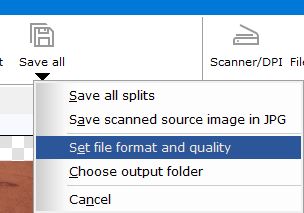
Use the Fileformat button to select output format or click the small black triangle below the Save All button to access a popup menu letting you launch the file format dialog.
 Choose the fileformat from the combobox. For JPEG you can also adjust quality.
You can also define wheter you want to save metadata inside the image file. Metadata is extra information that might come handy for further processing of image files. See "Metadata saving" tutorial section for more information. You can disable metadata saving partially or completely in this dialog as well. DPI information is useful for reproducing the photo in print. Metatag information holds the photo caption if you enter one.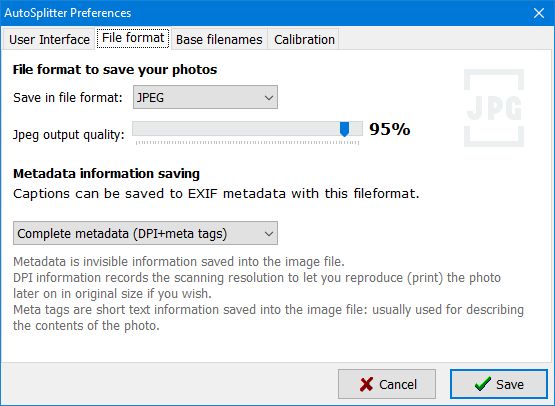
Choose the fileformat from the combobox. For JPEG you can also adjust quality.You can also define wheter you want to save metadata inside the image file. Metadata is extra information that might come handy for further processing of image files. See "Metadata saving" tutorial section for more information. You can disable metadata saving partially or completely in this dialog as well. DPI information is useful for reproducing the photo in print. Metatag information holds the photo caption if you enter one.